T-Tube Drainage After Bile Duct Exploration: Evidence
T-tube drainage or primary closure after common bile duct exploration? What Cochrane reviews, a 2021 meta-analysis and the BSG guideline report.
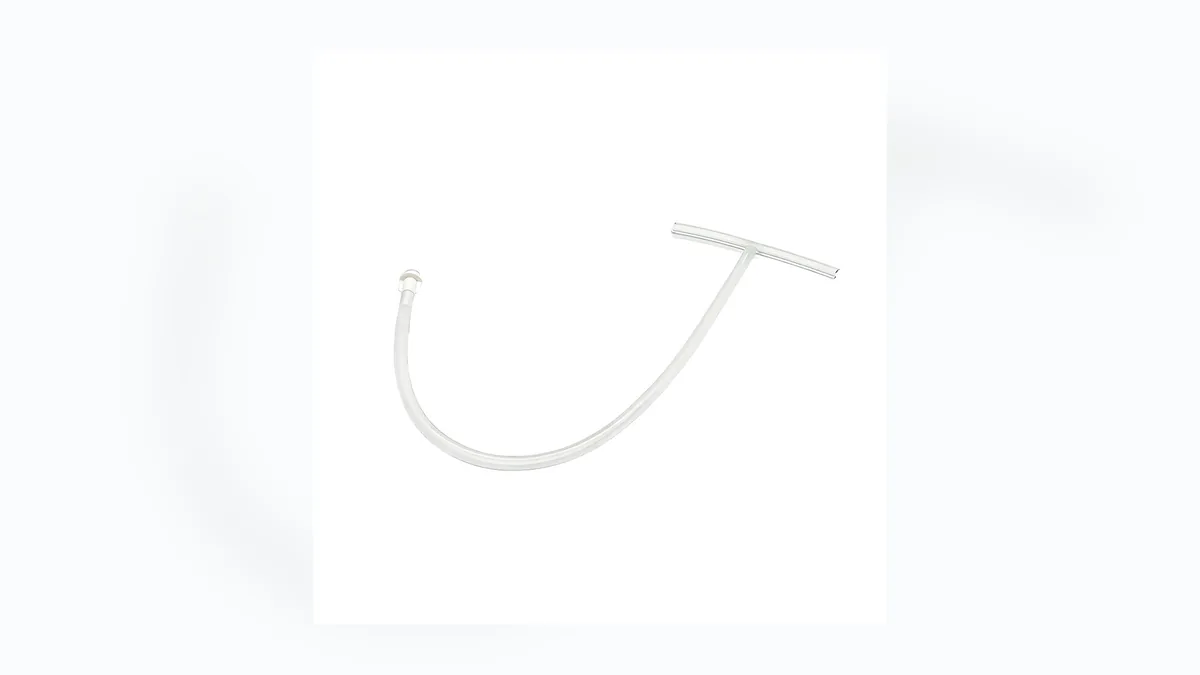
A T-tube, also called a biliary T-tube or T-drain, is a soft tube shaped like the letter T. After the common bile duct has been opened to remove stones (choledochotomy), the short crossbar of the T can be left inside the duct while the long limb is brought out through the abdominal wall to drain bile. For decades this was a standard way to finish a bile duct exploration. Today many surgeons close the duct primarily instead. This article summarises what systematic reviews and a national guideline say about the choice. It is for education only and does not replace surgical judgement or local protocols.
Why surgeons used T-tubes
According to the Cochrane reviews by Gurusamy and colleagues, T-tube drainage may prevent bile leakage from the biliary tract after bile duct exploration, and it offers access to the bile ducts after surgery for imaging and further stone removal. The 2017 British Society of Gastroenterology (BSG) guideline on common bile duct stones adds the historical reason: in open exploration, T-tubes were inserted because of the risk of bile leakage from the choledochotomy, which arose from uncertainty about whether the duct had been cleared (without choledochoscopy) or from oedema and inflammation caused by blind instrumentation of the duct.
Evidence after open bile duct exploration
The 2013 Cochrane review on open common bile duct exploration included six randomised trials with 359 participants: 178 had T-tube drainage and 181 had primary closure. All trials were at high risk of bias. Mortality did not differ significantly (1.2% versus 0.6%), and neither did the serious morbidity rate. Operating time was about 29 minutes longer with a T-tube (one trial), and hospital stay was about 4.7 days longer (five trials). The authors concluded that there is no justification for routine T-tube drainage after open exploration for common bile duct stones, and that T-tubes should not be used outside well-designed randomised trials.
Evidence after laparoscopic bile duct exploration
The companion 2013 Cochrane review on laparoscopic exploration included three randomised trials with 295 participants: 147 with T-tube drainage and 148 with primary closure, again all at high risk of bias. There were no deaths. Serious morbidity was 11.3% with a T-tube and 6.1% with primary closure, a difference that was not statistically significant. Operating time was about 21 minutes longer and hospital stay about 3.3 days longer in the T-tube group, and in one trial patients with a T-tube returned to work about eight days later. Here too, the authors found no justification for routine T-tube use.
A 2021 meta-analysis by Zhu and colleagues in the Journal of Zhejiang University Science B pooled six randomised trials and ten cohort studies with 1,865 patients undergoing laparoscopic exploration. In the randomised trials, primary duct closure was better than T-tube drainage for operating time, total postoperative complications, postoperative hospital stay and hospital costs. There were no significant differences in bile leakage, retained stones, stone recurrence, bile duct stricture or postoperative pancreatitis. The authors concluded that primary closure can be the first choice after transductal laparoscopic exploration.
What the BSG guideline says
The BSG guideline explains that laparoscopic exploration, with optical magnification, direct vision and finer instruments, causes less trauma to the bile duct and has led to more primary closure. Primary closure avoids the morbidity of T-tubes, which the guideline lists as the discomfort of living with a T-tube through the abdominal wall for 10 to 14 days, the risk of accidental early removal leading to bile leakage, peritonitis and reoperation, and the need for postoperative T-tube cholangiograms. A small number of bile leaks also occur after planned T-tube removal. The guideline notes that studies show primary closure with shorter hospital stay and a similar number of bile leaks and recurrent stones.
Where this leaves the T-tube
The reviews argue against routine use, not against every use. All the included trials carried a high risk of bias, and the Cochrane authors call for further trials that also assess long-term outcomes such as bile duct stricture and recurrent stones. Whether to place a T-tube in an individual patient remains a surgical decision. For how closed and open drains compare more broadly, see our review of closed-suction and passive surgical drains.
A note for bariatric patients
Bile duct stones are harder to reach after Roux-en-Y gastric bypass, because the long limb created at surgery keeps a standard endoscope away from the papilla. The BSG guideline recommends that patients with a gastric bypass and bile duct stones be referred to centres that can offer the advanced endoscopic and surgical options needed. It cites a US series of 56 patients in which laparoscopy-assisted ERCP (endoscopic retrograde cholangiopancreatography) succeeded in 100% of cases compared with 59% for long-limb enteroscopy.
Our T-tube
The Shenyun T-tube is made of 100% medical-grade silicone and, according to its datasheet, is intended for biliary and abdominal drainage. It is listed in 12 Fr and 18 Fr.
Sources: - Gurusamy KS, Koti R, Davidson BR. T-tube drainage versus primary closure after open common bile duct exploration. Cochrane Database Syst Rev 2013 (CD005640.pub3) - Gurusamy KS, Koti R, Davidson BR. T-tube drainage versus primary closure after laparoscopic common bile duct exploration. Cochrane Database Syst Rev 2013 (CD005641.pub3) - Zhu T, Lin H, Sun J, Liu C, Zhang R. Primary duct closure versus T-tube drainage after laparoscopic common bile duct exploration: a meta-analysis. J Zhejiang Univ Sci B 2021 (doi:10.1631/jzus.B2100523) - Williams E et al. Updated guideline on the management of common bile duct stones (CBDS). Gut 2017;66:765-782 (BSG)