Closed-Suction vs Passive Surgical Drains: Narrative Review
Structured narrative review (v1.0) of closed-suction and passive surgical drains: design, materials, suction pressure and clinical evidence.
Technical paper · Structured narrative review · Version 1.0 · November 2026
Full title: Closed-Suction versus Passive Surgical Drains: Design, Materials and Clinical Evidence — A Structured Narrative Review
This page presents a structured narrative review prepared by Suzhou Shenyun Medical Equipment Co., Ltd., a company that manufactures single-use silicone medical devices, including silicone surgical drains with cross-shaped and spiral anti-clog profiles and closed-suction drainage sets. It is a review of published studies, not a clinical study, and no company product is evaluated or compared in it. Please read the Conflict of Interest statement below.
Authors and affiliation
Yuan Liu (刘源), Suzhou Shenyun Medical Equipment Co., Ltd., Suzhou, China. Corresponding author: Yuan Liu, https://sybariatric.com/contact.
Article type: structured narrative review (industry-prepared). Display items in the full text: 7 figures, 6 tables; 94 references. DOI: 10.5281/zenodo.23874543 (concept DOI, always resolves to the latest version). Licence: CC BY 4.0.
Full text (PDF, open access, version 1.0, 44 pages) on Zenodo: doi:10.5281/zenodo.23874543.
Abstract
Background. Surgical drains are placed after many operations to evacuate blood, serum, lymph or other fluid from wounds and body cavities. They are passive (gravity, siphon, capillary action) or active closed-suction systems driven by a bulb, spring or evacuated reservoir. Device-level choices are rarely discussed together with the clinical evidence.
Methods. Four PubMed/MEDLINE searches were run through the NCBI E-utilities on 2 November 2026 (publication dates 1 January 1990 to 31 October 2026). Records were screened in two stages and outcomes were extracted as reported. Every reference was checked against PubMed and Crossref. No new meta-analysis was performed.
Results. The searches returned 1056 records (918 unique); 94 reports were included (83 from the searches and 11 from other sources). Across specialties, meta-analyses found no consistent reduction in infection or haematoma with routine closed-suction drainage, whereas drains were associated with higher transfusion rates after hip and knee arthroplasty (risk ratio [RR] 1.43, 95% CI 1.19–1.72) and longer hospital stay after thyroid and axillary surgery (mean differences 0.88–1.52 days). Drains reduced seroma after axillary dissection (odds ratio [OR] 0.46, 0.23–0.91) and totally extraperitoneal hernia repair (OR 0.12, 0.05–0.29). Higher suction increased drained volume in randomised trials without a consistent clinical gain. Bench studies showed that reservoir negative pressure (−71 to −175 mmHg when empty) falls steeply as the reservoir fills and depends on how the bulb is compressed. Evidence on cross-sectional design and material is limited to small trials, laboratory studies and case reports.
Conclusions. Routine drainage is not supported for most clean procedures; selective use is reasonable where seroma or large dead space is expected. When a drain is used, its function depends on lumen design, size, reservoir behaviour and timely removal as much as on the active/passive choice. Device-specific outcome data are scarce.
Keywords: surgical drains; closed-suction drainage; passive drainage; Penrose drain; Jackson-Pratt drain; Redon drain; Blake drain; seroma; haematoma; surgical site infection; silicone; medical devices.
Scope
The review covers wound and cavity drains across orthopaedic, breast and plastic, thyroid and neck, abdominal, hernia and obstetric surgery: physical principles, cross-sectional design, size and radiopaque marking, reservoirs and pressure profiles, materials (silicone, PVC, latex rubber and polyurethane), drain versus no drain, closed-suction versus passive drainage, suction level, drain-related complications and removal criteria. Drainage after bariatric surgery is addressed in a separate review. Chest tubes, cerebrospinal-fluid drains, percutaneous drainage of collections and negative-pressure wound therapy dressings are outside its scope.
Selected figures
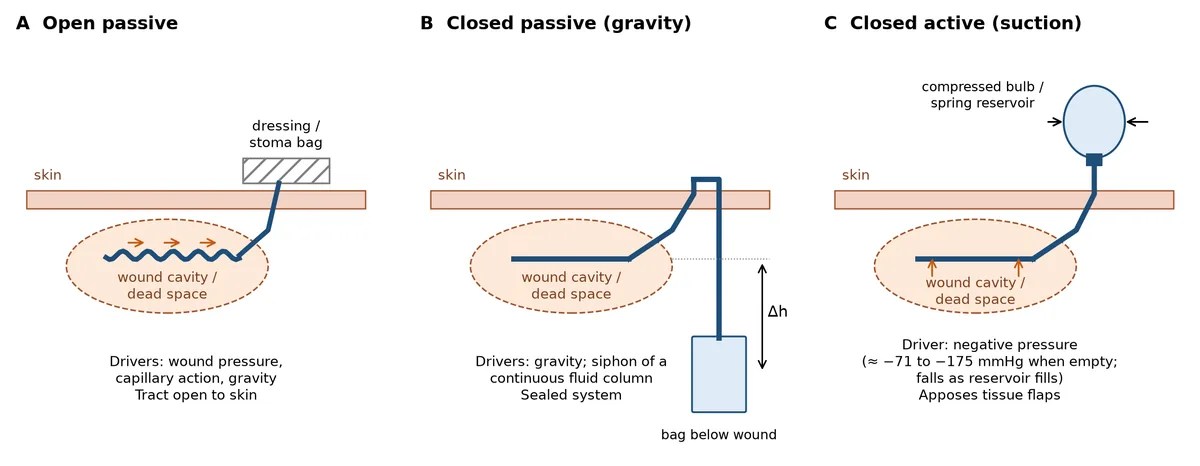
Header image, Figure 2. Schematic comparison of drainage principles (original drawing, not to scale). A, open passive drain: fluid moves along a corrugated or Penrose-type drain by wound pressure, gravity and capillary action into a dressing or stoma bag. B, closed passive (gravity/siphon) drain: a tube leads to a sealed bag placed below the wound, and the height difference of a continuous fluid column drives flow. C, active closed-suction drain: a compressed bulb or spring-loaded reservoir generates negative pressure that falls as the reservoir fills. The range shown in C (about −71 to −175 mmHg with an empty reservoir) is the range of maximal values measured for three commercial systems in one bench study; it is not a recommendation.

Figure 3. Schematic cross-sections of common surgical drain profiles (original drawing, illustrative and not to scale; no specific commercial product is depicted). A, round tube with side holes; B, fluted four-channel drain (Blake-type); C, flat multichannel drain; D, cross-shaped anti-clog profile with four open channels; E, spiral-channel profile (side view); F, corrugated sheet drain; G, Penrose-type collapsible tube. A–E are used as closed drains, with suction or passively; F and G are open passive drains. The dashed circle marks the outer diameter used for French sizing (outer diameter in mm × 3).
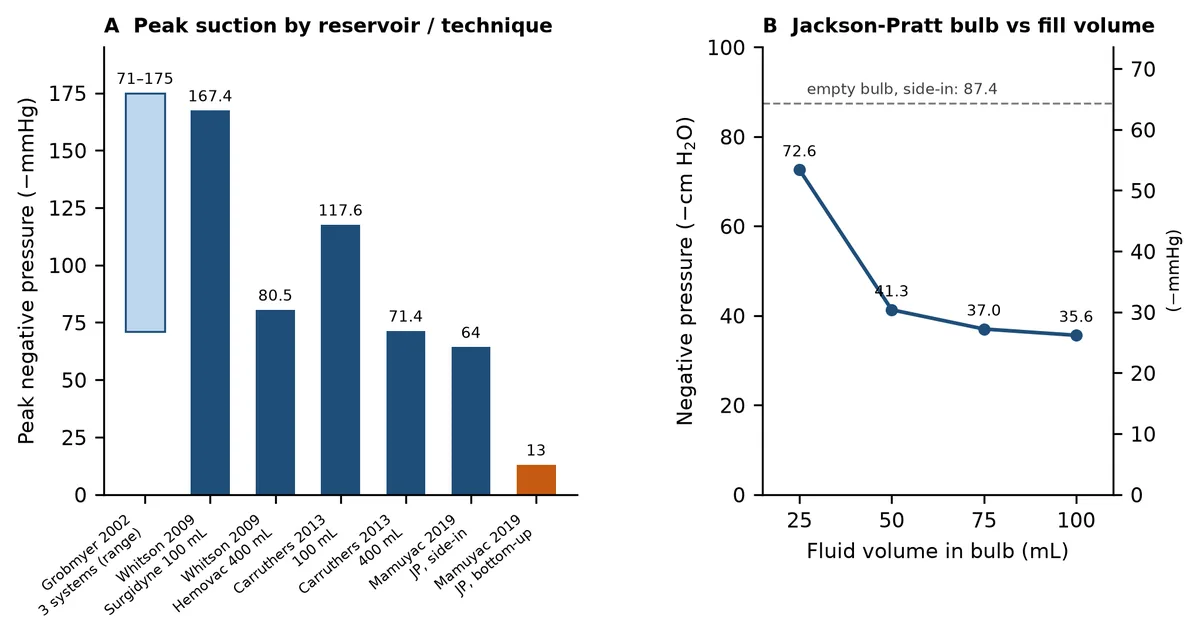
Figure 4. Bench measurements of closed-suction reservoir pressure. (A) Peak negative pressure reported for different reservoirs and activation methods in four bench studies; (B) negative pressure in a Jackson-Pratt bulb with increasing fluid volume, as reported in one study. Values are those reported in the cited abstracts; no new measurements were made.

Figure 5. Pooled effect estimates for drain versus no drain, as reported in the cited meta-analyses. (A) Ratio outcomes (risk ratio or odds ratio as reported, log scale; values below 1 favour drainage for adverse outcomes); (B) length of hospital stay (mean difference in days; positive values indicate a longer stay with drains). Only estimates reported with a 95% CI in the source abstract are shown; no re-analysis was performed.
How to cite
Liu Y. Closed-Suction versus Passive Surgical Drains: Design, Materials and Clinical Evidence — A Structured Narrative Review. Version 1.0. Zenodo; 2026. doi:10.5281/zenodo.23874543. Available from: https://doi.org/10.5281/zenodo.23874543
Conflict of Interest
The author is the General Manager of Suzhou Shenyun Medical Equipment Co., Ltd., a company that manufactures single-use silicone medical devices including surgical drainage products. The company therefore has a commercial interest in the topic of this review. No company product is evaluated or compared in this review. This work received no external funding.
Related reading on this site
Shorter articles on surgical drainage: suction drains and closed-system details (NCBI Bookshelf) and WHO surgical-site infection guidance and the closed drainage workflow.
Sources: - Zenodo (concept DOI 10.5281/zenodo.23874543, resolves to the latest version)
This article summarises a published narrative review for healthcare professionals. It is not medical advice and not a clinical guideline; the decision whether to use a drain, and which type, remains with the operating surgeon and the surgical team.