2-Way vs 3-Way Foley Catheter: Differences and Uses
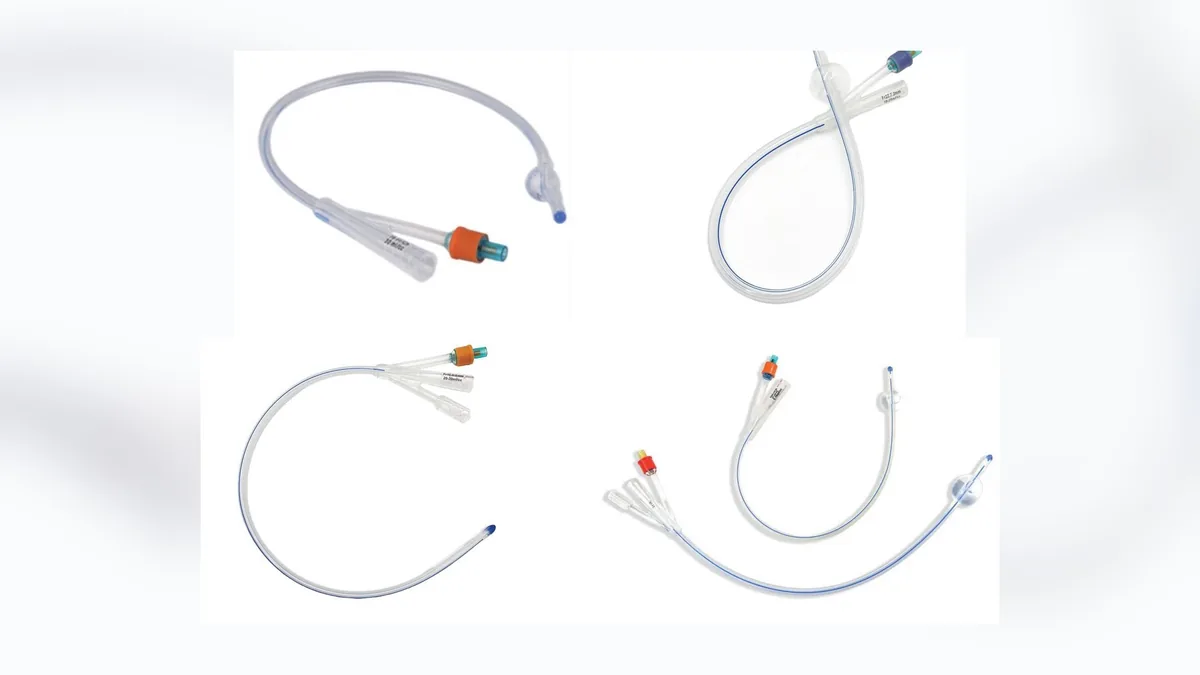
Two-way and three-way Foley catheters compared: lumens, typical French sizes, balloon volumes, continuous bladder irrigation and catheter materials.
The Foley catheter, also called an indwelling urinary catheter (IUC or IDC) or balloon catheter, is the most common way to drain the bladder continuously. It comes in two main versions, the 2-way and the 3-way Foley catheter. They look similar, but they are built for different jobs. This article explains the difference using guidance from urology nursing and urology societies. It is for education only and does not replace local protocols or the manufacturer's instructions.
What a Foley catheter is
A Foley catheter is a flexible tube passed through the urethra into the bladder. Urine drains through eyelets near the tip, and a small balloon just behind the eyelets is inflated inside the bladder to hold the catheter in place. A StatPearls review on difficult Foley catheterization notes that catheter size is measured in French (Fr), where one French equals 0.33 mm, and that Foley catheters can be made of latex, plastic or silicone. The European Association of Urology Nurses (EAUN) guideline adds a little history: the first indwelling catheter with a balloon was developed in 1853, Dr Frederick Foley redesigned it in 1932, and "Foley catheter" is now the general name for the two-way urinary catheter.
The 2-way Foley catheter
A 2-way catheter has two channels: a larger one that drains urine and a small one used to inflate and deflate the balloon. StatPearls calls it the standard Foley catheter. The EAUN guideline lists its indications as standard transurethral catheterisation and standard suprapubic catheterisation. In everyday ward use, this is the catheter for urinary retention, monitoring urine output and similar drainage needs.
The 3-way Foley catheter
A 3-way catheter adds a third, smaller channel through which sterile fluid can run into the bladder while urine and fluid drain out through the main channel. This is what makes continuous bladder irrigation (CBI) possible. The EAUN guideline lists two indications: continuous irrigation after urological surgery, and bladder washout or irrigation to clear blood clots or debris. The American Urological Association (AUA) medical student curriculum describes gross haematuria and clot retention as typical situations that need a 3-way catheter. The British Association of Urological Surgeons (BAUS) explains that continuous irrigation keeps the catheter open and free of clots, dilutes haematuria and helps prevent new clots while the bleeding settles.
Why 3-way catheters are usually larger
Because a 3-way catheter divides its cross-section into three channels, each channel is narrower than in a 2-way catheter of the same size. The AUA curriculum therefore advises a larger size, 20 to 24 Fr, for 3-way catheters, and StatPearls notes that 3-way catheters are generally at least 20 Fr. BAUS recommends a large-bore 3-way catheter of 20 to 22 Fr for continuous bladder irrigation. The AUA also describes stiffer haematuria catheters of 22 to 24 Fr with balloons of about 30 mL that can be used for tamponade of the prostate when the catheter is placed on traction. For converting French sizes into millimetres, see our French size to mm conversion chart.
Balloon volume and labelling
The balloon volume is printed on the catheter connection after the size, as a minimum and maximum, for example Ch 12 / 5 to 10 mL, according to the EAUN guideline. The guideline also warns that a catheter with a 30 mL balloon is designed specifically as a haemostat after urological procedures and should not be used for routine catheterisation. The balloon volume can differ between products, so the manufacturer's instructions should always be followed.
Material: latex or silicone
Both 2-way and 3-way catheters are made in different materials. The EAUN guideline compares them: latex catheters are flexible and cheap but not suitable for people with latex allergy and carry more risk of irritation, so they are recommended for short-term use of under 14 days. All-silicone catheters have a wider lumen than latex, tend to encrust less and are suitable for people with latex allergy, so they are suited to long-term use of over 14 days; their drawbacks are lower flexibility and a balloon that may lose fluid by diffusion over time. Other options include hydrogel-coated and silicone-coated latex. StatPearls adds that antimicrobial coatings are available but have limited proven efficacy.
Quick comparison
A 2-way Foley catheter has two channels (drainage and balloon) and is used for routine bladder drainage. A 3-way Foley catheter has three channels (drainage, balloon and irrigation inflow), is usually 20 Fr or larger and is used for continuous bladder irrigation or washout after urological surgery or with haematuria and clots. Which catheter, size and balloon to use is always a clinical decision.
Our range
Shenyun's Foley catheters are made of 100% silicone and are latex-free. According to the technical data sheet, the 2-way version comes in 8 to 26 Fr and the 3-way version, which also allows bladder irrigation, in 18 to 30 Fr.
Sources: - European Association of Urology Nurses (EAUN). Indwelling catheterisation in adults - urethral and suprapubic: Equipment and products - American Urological Association. Medical Student Curriculum: Bladder Drainage - British Association of Urological Surgeons. Bladder washout & irrigation - Difficult Foley Catheterization. StatPearls, NCBI Bookshelf