Intraoperative Leak Test in Sleeve Gastrectomy: The Evidence
Most centres test the staple line in sleeve gastrectomy. What large studies show about the leak test, and what a negative result cannot tell you.
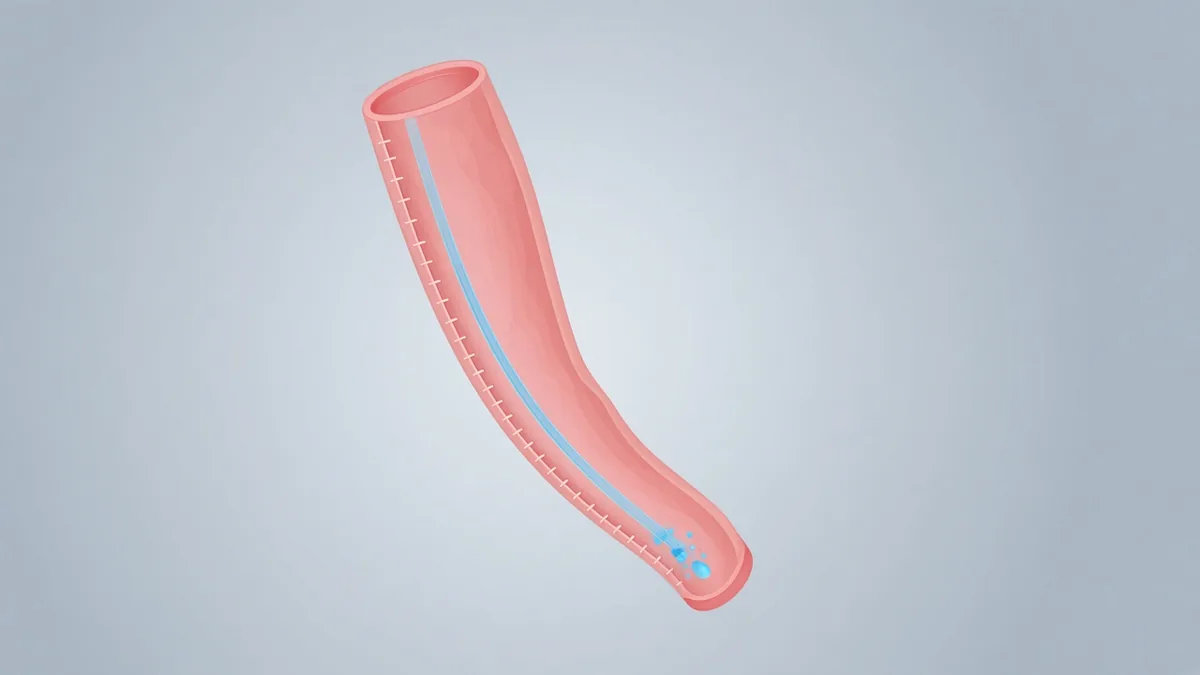
A staple-line leak is one of the most feared complications of laparoscopic sleeve gastrectomy. To look for a defect before the operation ends, many teams perform an intraoperative leak test: the distal sleeve is occluded and methylene blue or air is introduced through the bougie or an orogastric tube while the surgeon watches the staple line. This article brings together what published studies say about the test. Its purpose is clinical education; it does not recommend one practice over another.
How common is the intraoperative leak test?
Testing is the norm in many countries. A 2025 national survey of Polish bariatric centres covered 54 centres and 7,450 sleeve gastrectomies performed in 2023. A leak test was part of routine practice in 84.3% of centres, and 70% of centres used a 36 Fr calibration device. The reported mean leak rate was 0.33% and the mean bleeding rate 0.98%. These are self-reported figures, and the authors acknowledge the limits of a survey design.
In the United States, an analysis of the MBSAQIP registry covering 265,309 primary bariatric operations found that a test was performed in 81.9% of cases.
Does testing reduce sleeve gastrectomy leaks?
The large datasets do not show a protective effect. In the MBSAQIP analysis, patients who were tested and those who were not had similar rates of leak and of leak-related outcomes. For sleeve gastrectomy, the test added on average about 9.5 minutes of operating time. The authors concluded that the data showed neither clear benefit nor clear harm.
A 2024 systematic review and meta-analysis pooled 6 studies with 469,588 patients. The leak rate was 0.38% with testing and 0.31% without (OR 1.27). Postoperative bleeding was less frequent in the tested group (OR 0.79), and 30-day mortality and readmission did not differ. All included studies were observational, so these associations do not prove cause and effect; centres that test routinely may also differ in case mix and technique.
What a negative test cannot tell you
A single-centre series of 1,550 sleeve gastrectomies illustrates the point. A test was done in 1,329 operations and none was positive. Fifteen patients (1%) later developed a leak, and the rate was the same whether or not a test had been performed. Leaks presented on average on day 17.3 after surgery, with a range of 1 to 67 days. In two patients the test was repeated when the leak was diagnosed, and it was still negative.
Practical takeaways for surgical teams
Reading these studies together, a negative intraoperative test shows that the staple line was intact at that moment. It does not rule out a leak that appears days or weeks later. Teams that continue to test often value it as a check of technique and a teaching tool; teams that have stopped point to the time it adds and the absence of outcome benefit in registry data. Whichever approach a unit chooses, a written protocol, clear operative notes and patient education about warning signs after discharge remain important, because many leaks are diagnosed after the patient has gone home.
Related guide: Bougie size in sleeve gastrectomy evidence review 2026
Sources: - Sroczyński P et al. Videosurgery and Other Miniinvasive Techniques 2025, national survey of Polish bariatric centres (doi:10.20452/wiitm.2025.17954) - Yolsuriyanwong K et al. Surg Obes Relat Dis 2019, MBSAQIP analysis (doi:10.1016/j.soard.2019.06.008) - Ma L et al. Int J Surg 2024, systematic review and meta-analysis (doi:10.1097/JS9.0000000000000919) - Sethi M et al. Surg Endosc 2016 (doi:10.1007/s00464-015-4286-7)
This article is for general educational purposes for healthcare professionals and does not constitute medical advice. Decisions about surgical technique rest with the operating surgeon and the multidisciplinary team.