Bougie Size and Leak Testing in Sleeve Gastrectomy: Review
Structured narrative review (v1.1) of bougie size, calibration-device design and intraoperative leak testing in sleeve gastrectomy. Open-access PDF.
Technical paper · Structured narrative review · Version 1.1 · November 2026
Full title: Calibration Bougie Size Selection and Intraoperative Leak Testing in Laparoscopic Sleeve Gastrectomy: A Structured Narrative Review of Clinical Evidence and Device Design
This page presents a structured narrative review prepared by Suzhou Shenyun Medical Equipment Co., Ltd., a company that manufactures gastric calibration tubes, including a balloon-type model. It is a review of published studies, not a clinical study, and it reports no clinical data on the company's products. Please read the Conflict of Interest statement below.
Authors and affiliation
Yuan Liu (刘源), Suzhou Shenyun Medical Equipment Co., Ltd., Suzhou, China. Corresponding author: Yuan Liu, https://sybariatric.com/contact.
Article type: structured narrative technical review (industry-prepared). Display items in the full text: 6 figures, 5 tables, 1 box; 65 references. DOI: 10.5281/zenodo.23855184. Licence: CC BY 4.0.
Full text (PDF, open access on Zenodo): download from Zenodo, doi:10.5281/zenodo.23855184. Zenodo record page: zenodo.org/records/23855184.
Abstract
Background. Laparoscopic sleeve gastrectomy (LSG) is usually performed over an orogastric calibration device ("bougie") that guides the vertical staple line, and many surgeons finish the operation with an intraoperative leak test (IOLT). Both steps are routine, yet the evidence behind the choice of bougie diameter and the value of routine leak testing is mixed.
Objective. To summarise, in a structured and reproducible way, the published clinical evidence on bougie size (weight loss, staple-line leak, gastro-oesophageal reflux disease [GERD], stricture and early morbidity), on calibration-device design, and on IOLT (diagnostic performance and association with outcomes).
Methods. Three PubMed/MEDLINE searches were run through the NCBI E-utilities interface (publication dates up to 31 October 2026), supplemented by reference-list checking. Records were screened by title and abstract; eligible reports were assessed using PubMed abstracts and, where openly available, PubMed Central full texts. Study characteristics and outcomes were extracted as reported; values not reported were recorded as "NR". Diagnostic sensitivity was recalculated from reported counts with Wilson 95% confidence intervals (CIs), and the published pooled odds ratios (ORs) for IOLT were checked by Mantel–Haenszel recalculation from the per-study counts reported in the source meta-analysis. No new meta-analysis of bougie size was performed.
Results. The searches returned 394 records (370 unique); 65 reports were included. Twenty primary studies (126 to 692,554 patients) and six evidence syntheses addressed bougie size. Smaller bougies were associated with modestly greater weight loss in most comparative datasets and syntheses (for example, a pooled mean difference of 6.7% excess weight loss for 32–36 Fr in the most recent meta-analysis), but also with more stricture and reflux in that analysis (OR 2.14 and 1.76). Associations with leak were inconsistent: older pooled series and one registry favoured ≥38–40 Fr, whereas a randomised trial, later meta-analyses and recent registries did not. For IOLT, sensitivity for later clinical leak ranged from 0% to 22% in conventional-test cohorts (2 of 23 leaks detected in the largest multicentre series), and positive tests were rare (0–1.7%). Our recalculation reproduced the published pooled ORs exactly (leak 1.27, 95% CI 1.14–1.42; bleeding 0.79, 0.72–0.87).
Conclusions. No single bougie diameter has been shown to be optimal; ranges of about 33–40 Fr are proposed by recent syntheses as a compromise between weight loss and complications, and bougie size should be considered together with the distance from the pylorus and the angle of His. A negative IOLT does not exclude a later leak, and routine IOLT has not been shown to reduce leaks, although registry data associate it with less postoperative bleeding. Evidence on individual calibration-device features remains limited.
Keywords: sleeve gastrectomy; bariatric surgery; calibration bougie; bougie size; staple-line leak; gastro-oesophageal reflux; stricture; intraoperative leak test; methylene blue; intraoperative endoscopy; indocyanine green; medical devices.
Selected figures
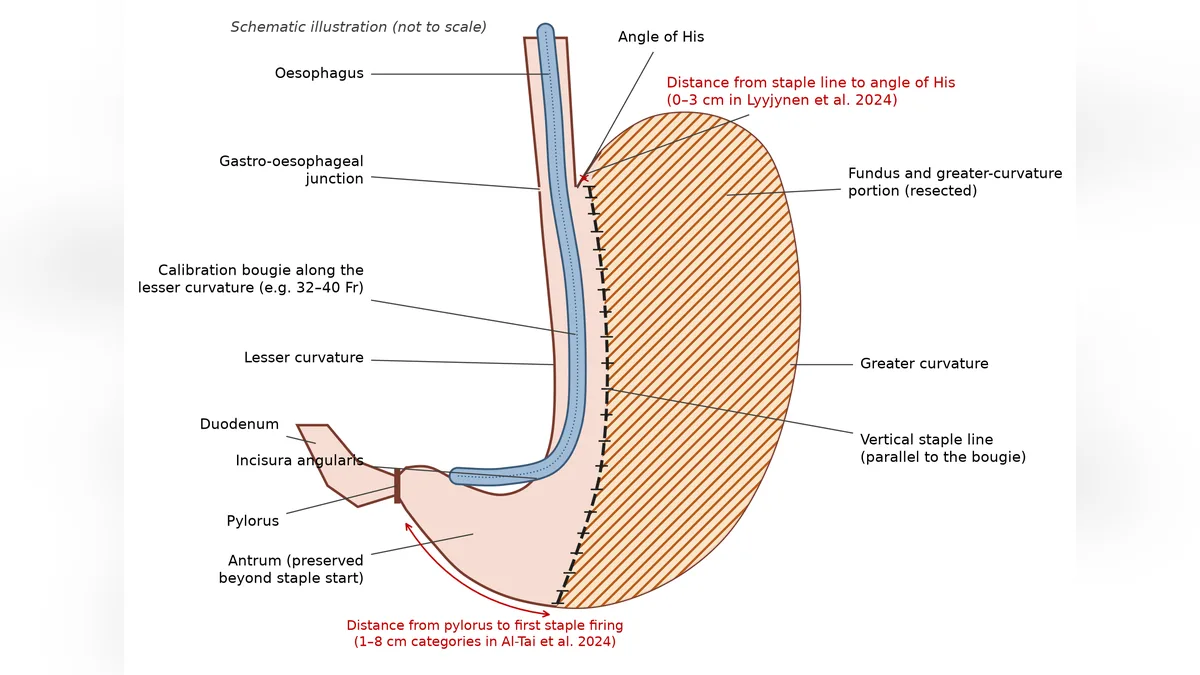
Header image, Figure 1. Schematic illustration of sleeve gastrectomy calibration (original drawing, not to scale). The calibration bougie lies along the lesser curvature and the vertical staple line is fired parallel to it, starting at a chosen distance from the pylorus and ending at a chosen distance from the angle of His. The distance ranges shown (1–8 cm from the pylorus, 0–3 cm from the angle of His) are the categories or inclusion ranges used in two registry studies; they are not recommendations.
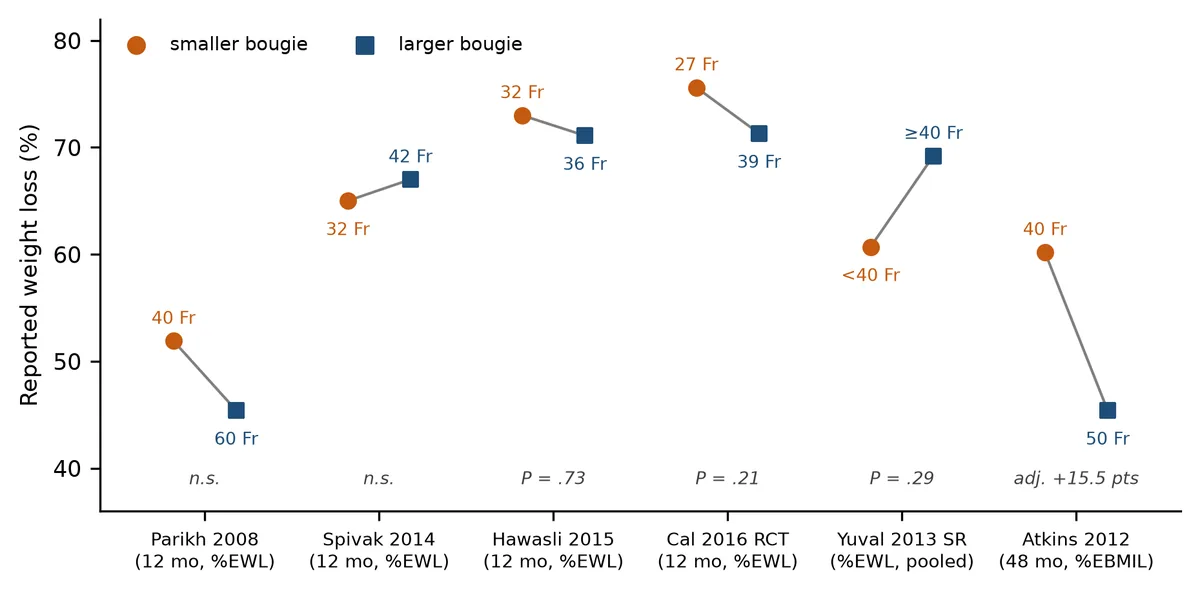
Figure 3. Weight loss reported by bougie size in the comparative studies and the systematic review that reported group-level values. Each pair connects the value for the smaller and the larger bougie in the same study. Outcome measures and time points differ between studies, so values are not directly comparable across studies. These are reported values from the cited studies, not a new meta-analysis.
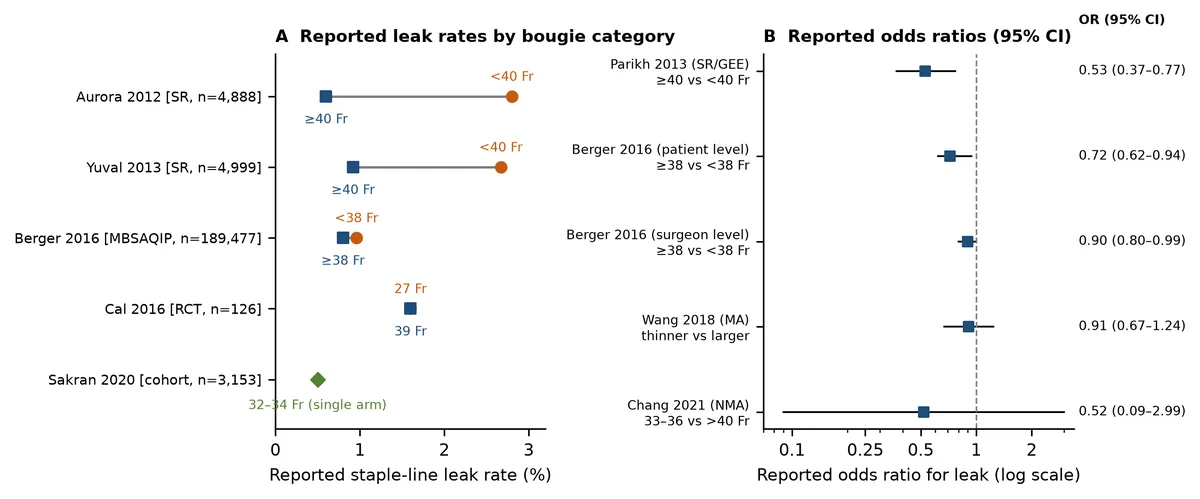
Figure 4. Staple-line leak and bougie size as reported in the cited studies. (A) Leak rates reported for smaller and larger bougie categories; (B) odds ratios for leak with 95% CIs as reported by the authors. Reported values only; no pooled estimate was calculated.
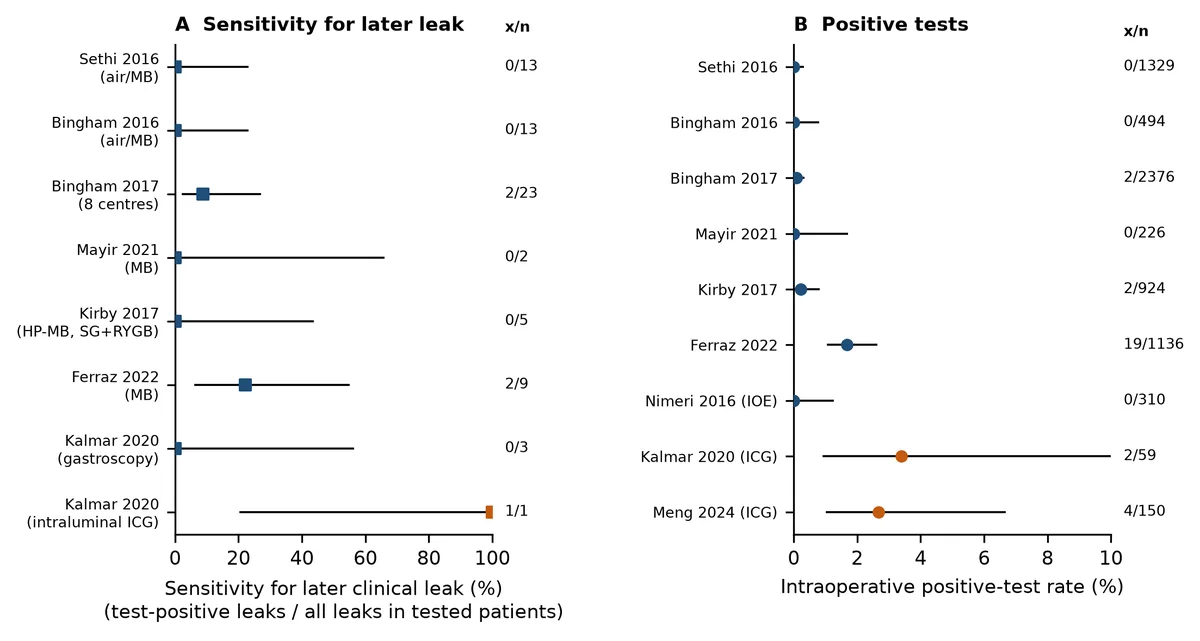
Figure 5. Diagnostic yield of intraoperative leak tests in the cited cohorts. (A) Sensitivity for later clinical leak (test-positive leaks divided by all leaks in tested patients); (B) proportion of intraoperative tests that were positive. Points are proportions recalculated from the reported counts, with Wilson 95% CIs calculated by the author.
How to cite
Liu Y. Calibration Bougie Size Selection and Intraoperative Leak Testing in Laparoscopic Sleeve Gastrectomy: A Structured Narrative Review of Clinical Evidence and Device Design. Version 1.1. Zenodo; 2026. doi:10.5281/zenodo.23855184. Available from: https://doi.org/10.5281/zenodo.23855184
Conflict of Interest
This review was prepared by Suzhou Shenyun Medical Equipment Co., Ltd. (Suzhou, China), a company that designs, manufactures and sells gastric calibration tubes (bougies) for bariatric surgery, including the products described in Box 1. The author, Yuan Liu, is the General Manager of Suzhou Shenyun Medical Equipment Co., Ltd. The company therefore has a direct commercial interest in the subject of this review. The review does not report clinical data on the company’s products. No external funding was received.
Related reading on this site
Shorter evidence summaries on the same topics: Bougie size in sleeve gastrectomy: evidence review 2026 and Intraoperative leak test in sleeve gastrectomy: the evidence.
Sources: - Zenodo record (DOI 10.5281/zenodo.23855184) - Zenodo record page
This article summarises a published narrative review for healthcare professionals. It is not medical advice and not a clinical guideline; the choice of calibration size and leak-testing technique remains the decision of the operating surgeon and the bariatric team.