Prophylactic Drainage after Bariatric Surgery: Review
Structured narrative review (v1.0) of prophylactic abdominal drainage after sleeve and bypass: evidence, guidelines and drain selection.
Technical paper · Narrative review with structured literature search · Version 1.0 · November 2026
Full title: Prophylactic Abdominal Drainage after Bariatric Surgery: A Narrative Review of the Evidence and Practical Considerations for Drain Selection
This page presents a narrative review prepared by Suzhou Shenyun Medical Equipment Co., Ltd., a company that manufactures single-use silicone medical devices, including silicone surgical drains with cross-shaped and spiral anti-clog profiles and closed-suction drainage sets. It is a review of published studies, not a clinical study, and no company product is evaluated or compared in it. Please read the Conflict of Interest statement below.
Authors and affiliation
Yuan Liu (刘源), Suzhou Shenyun Medical Equipment Co., Ltd., Suzhou, China. Corresponding author: Yuan Liu, https://sybariatric.com/contact.
Article type: narrative review with a structured literature search (industry-prepared). Display items in the full text: 8 figures, 5 tables; 81 references. DOI: 10.5281/zenodo.24017382 (concept DOI, always resolves to the latest version). Licence: CC BY 4.0.
Full text (PDF, open access, version 1.0, 35 pages, 1.4 MB): Download PDF. Permanent citation link on Zenodo: doi:10.5281/zenodo.24017382.
Abstract
Background. Surgeons have long placed an intra-abdominal drain after sleeve gastrectomy and gastric bypass to detect staple-line leak or bleeding early and to control a leak without reoperation. Enhanced-recovery pathways and large registry analyses have challenged this practice. This review summarises the evidence on whether, when and how to drain after metabolic and bariatric surgery.
Methods. Four PubMed/MEDLINE searches were run through the NCBI E-utilities on 6 November 2026 (publication dates 1 January 1990 to 31 October 2026), supplemented by targeted look-ups. Records were screened in two stages; outcomes were extracted as reported, without re-pooling. Every reference was checked against PubMed and Crossref (DataCite for the one Zenodo record).
Results. The searches returned 2345 records (2169 unique); 81 reports were included. Only small randomised trials compared drain with no drain (66 and 84 patients after gastric bypass); both found more pain with drains and no detectable benefit. Registry analyses of 142,631 to 526,723 patients associated drains with higher adjusted odds of leak and reoperation and, in the most recent analyses, of organ-space infection and prolonged stay; these associations are probably confounded by selective drain use in higher-risk cases. Reported sensitivity of drains for leak ranged from 0% to 94.1%. Many leaks present after the usual drain-removal window. Drain amylase, judged against study-specific cut-offs, had high sensitivity and specificity in three single-centre series. The 2021 ERAS Society guideline and Canadian and Italian consensus statements advise against routine drainage; the 2016 ERAS guideline judged it probably unnecessary.
Conclusions. Current evidence does not support routine prophylactic drainage after primary bariatric surgery. Selective use in revisional operations, difficult anastomoses or recognised bleeding risk is common practice but remains unproven. If a drain is used, its type, position and removal should be planned.
Keywords: bariatric surgery; sleeve gastrectomy; Roux-en-Y gastric bypass; one-anastomosis gastric bypass; prophylactic drainage; anastomotic leak; postoperative haemorrhage; enhanced recovery after surgery; drain amylase; surgical drains.
Scope
The review addresses four questions: (1) what comparative evidence exists for and against prophylactic abdominal drainage after sleeve gastrectomy, Roux-en-Y gastric bypass, one-anastomosis gastric bypass and revisional procedures; (2) how well drains and drain-fluid analysis detect leak and bleeding; (3) what current guidelines recommend; and (4) if a drain is used, which device characteristics and management practices are relevant. A companion review by the same author covers closed-suction and passive drain design across surgical specialties in more depth; the device section here is limited to issues relevant to bariatric practice.
Selected figures
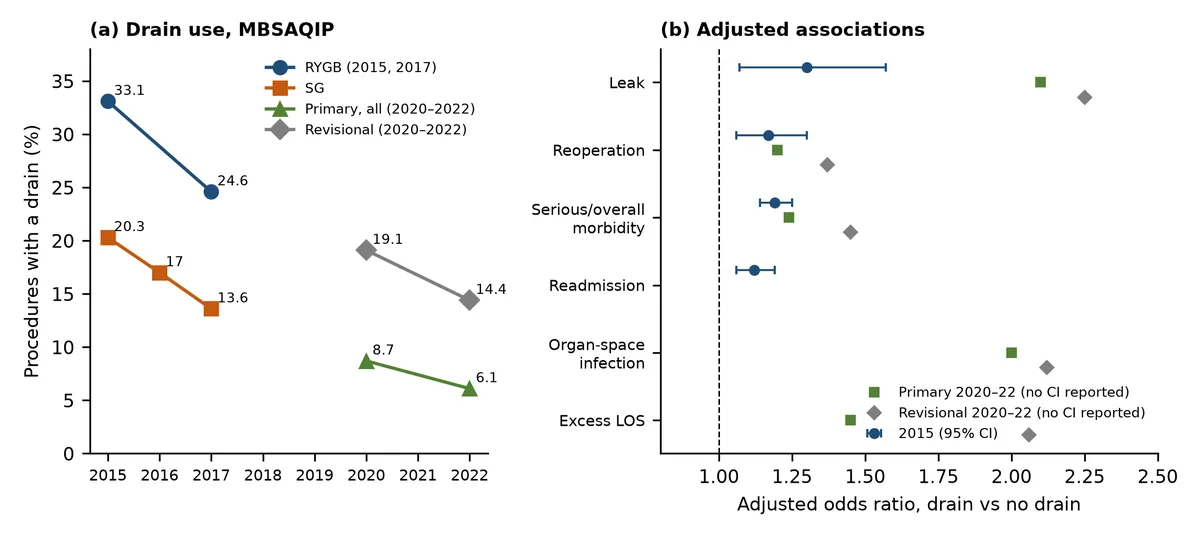
Header image, Figure 2. Drain use after bariatric surgery in the MBSAQIP registry and its association with outcomes, as reported. (a) Proportion of procedures with a drain across published registry windows; (b) adjusted odds ratios for outcomes in drained versus undrained patients. Values and confidence intervals are those reported in the cited sources; no re-analysis was performed.
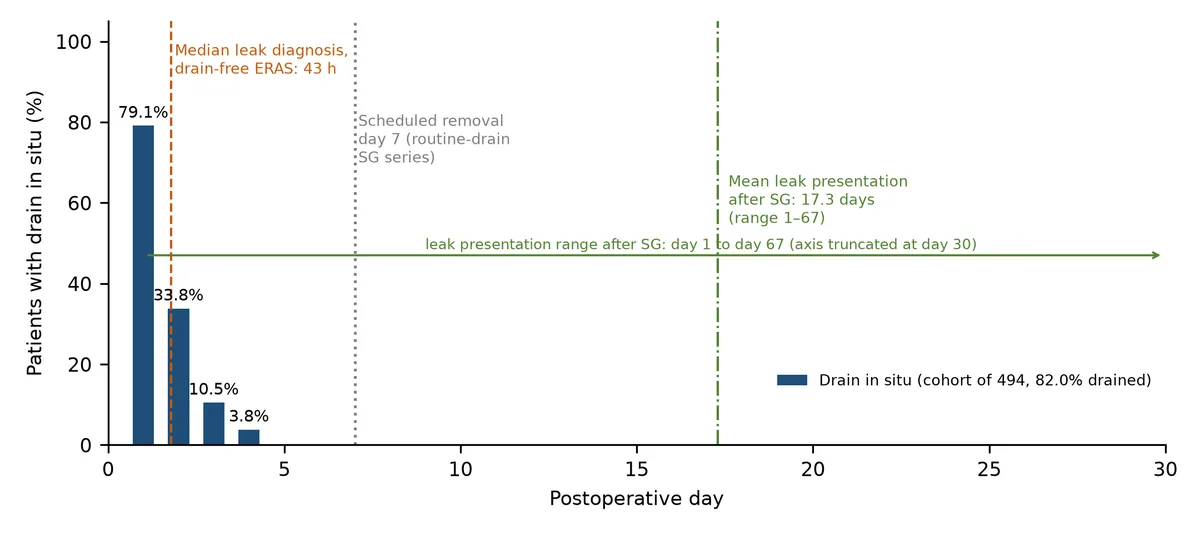
Figure 3. Timing of drain removal relative to the reported timing of leak presentation. Bars show the proportion of patients with a drain still in place on postoperative days 1–4 in one drained cohort. Markers show reported times to leak diagnosis or presentation in cited series, including a mean of 17.3 days after sleeve gastrectomy. Many leaks present after the usual drain-removal window.
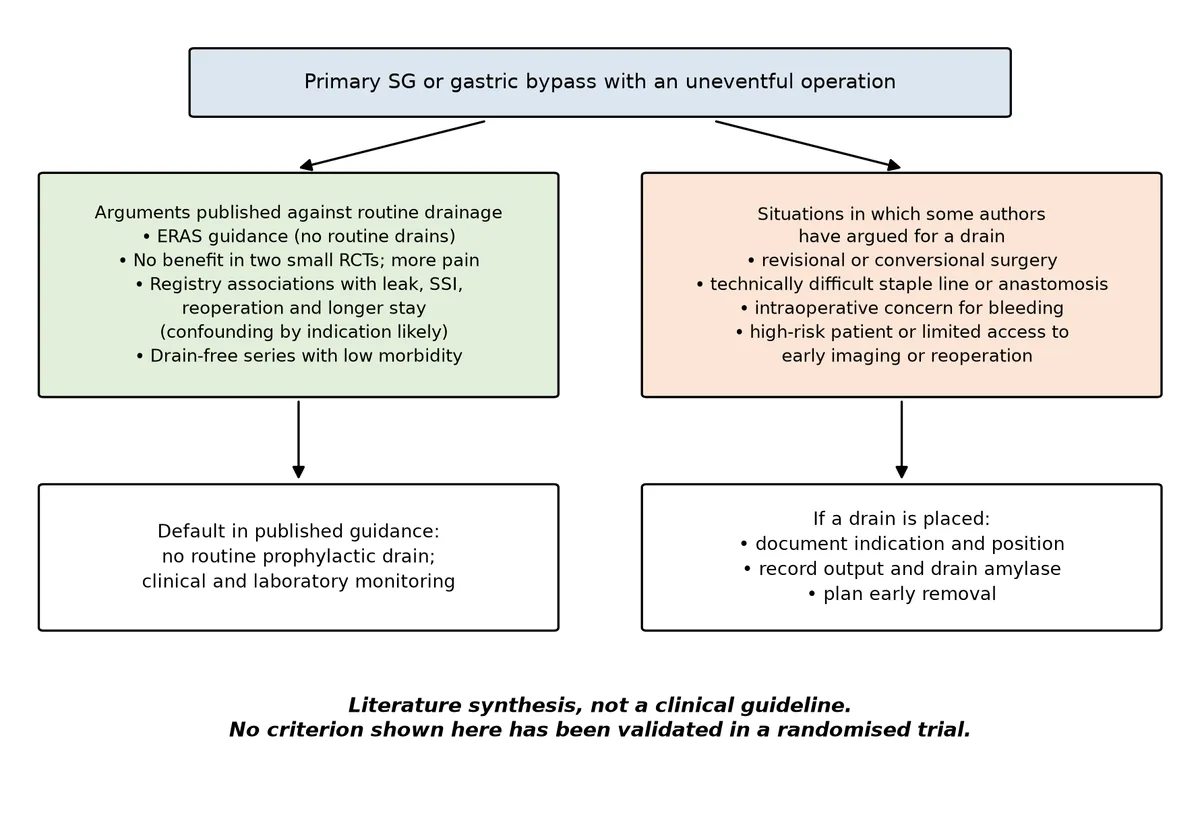
Figure 6. Considerations for selective prophylactic drainage after bariatric surgery: a decision aid synthesised from the literature reviewed. This is a literature synthesis, not a clinical guideline. The boxes indicate where published authors have argued for or against a drain; none of the criteria has been validated in a randomised trial.
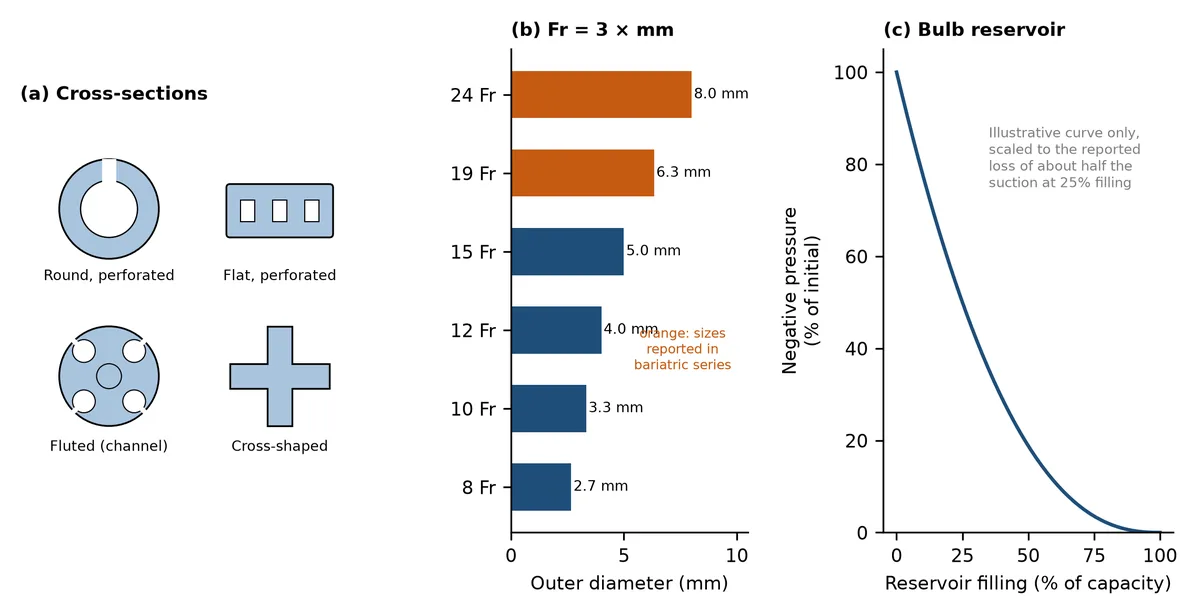
Figure 7. Schematic of common drain designs (original drawings, not to scale and not representing any specific commercial product). (a) Cross-sections of round perforated, flat perforated, fluted and cross-shaped silicone profiles; (b) French gauge (Fr = 3 × outer diameter in mm) with sizes reported in bariatric series; (c) closed-suction system with a bulb reservoir, whose negative pressure falls as it fills.
How to cite
Liu Y. Prophylactic Abdominal Drainage after Bariatric Surgery: A Narrative Review of the Evidence and Practical Considerations for Drain Selection. Version 1.0. Zenodo; 2026. doi:10.5281/zenodo.24017382. Available from: https://doi.org/10.5281/zenodo.24017382
Conflict of Interest
The author is the General Manager of Suzhou Shenyun Medical Equipment Co., Ltd., a company that manufactures single-use silicone medical devices including surgical drainage products. The company therefore has a commercial interest in the topic of this review. No company product is evaluated or compared in this review. This work received no external funding.
Related reading on this site
Companion technical paper on drain design: Closed-suction versus passive surgical drains: a structured narrative review.
Shorter clinical article on drain use after bariatric surgery: Drains after bariatric surgery: routine, selective or none?.
Sources: - Zenodo (concept DOI 10.5281/zenodo.24017382, resolves to the latest version)
This article summarises a published narrative review for healthcare professionals. It is not medical advice and not a clinical guideline; the decision whether to use a drain, and which type, remains with the operating surgeon and the surgical team.